254th Infantry Regiment- Page 10
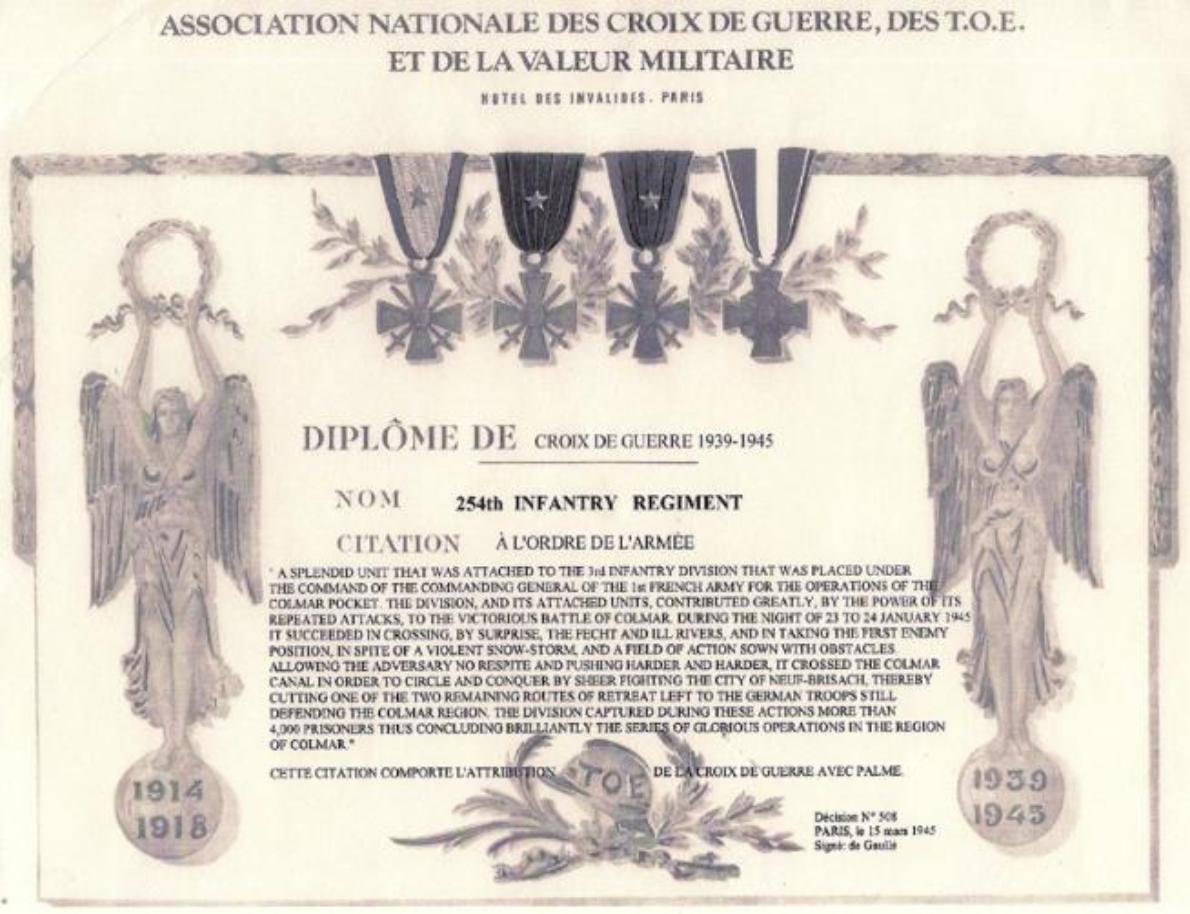
Presidential Unit Citations Received


By direction of the President of the United States of America, the Presidential Unit
Citation is awarded to the 3rd Infantry Division, with the following attached units:
254th Infantry Regiment, 63rd Infantry Division. Fighting incessantly from 22
Jan to 6 Feb 1945, in heavy snow storms, through enemy infested marshes and
woods and over a flat plain crisscrossed by numerous small canals, irrigation ditches
and unfordable streams, terrain ideally suited to the defense, breached the German
defense wall on the northern perimeter of the Colmar Bridgehead and drove
forward to isolate Colmar from the Rhine. Crossing the Fecht River from Guemar,
Alsace, by stealth during the late hours of darkness of 22 January, the assault
elements fought their way forward against mounting resistance. Reaching the Ill
River, a bridge was thrown across, but collapsed before armor could pass to the
support of two battalions of the 30th Infantry on the far side. Isolated and attacked
by a full German Panzer brigade, outnumbered and out gunned, these valiant troops
were forced back, yard by yard. Wave after wave of armor and infantry was
hurdled against them but despite hopeless odds the regiment held tenaciously to the
bridgehead. Driving forward in knee-deep snow, which masked acres of densely
sown mines, the 3rd Infantry Division fought from house to house and street to street
in the fortress towns of the Alsatian Plain. Under furious concentrations of
supporting fire, assault troops crossed the Colmar Canal in rubber boats during the
night of 29 January. Driving relentlessly forward, six towns were captured within 8
hours, 500 casualties were inflected on the enemy during the day, and large
quantities of booty seized. Slashing through to the Rhine-Rhone Canal, the garrison
at Colmar was cut off and the fall of the city assured. Shifting the direction of
attack, the division moved south between the Rhine-Rhone Canal and the Rhine
toward Neuf Brisach and the Brisach Bridge. Synchronizing the attacks, the bridge
was seized and Neuf Brisach captured by crossing the protecting moat and scaling
the medieval walls by ladder. In one of the hardest fought and bloodiest campaigns
of the war, the 3rd Infantry Division annihilated three enemy divisions, partially
destroyed three others and captured over 4000 prisoners and inflicted more than
7500 casualties on the enemy (WDGO 44, 6 Jun 1945)
Colmar, France
Jebsheim, France
By direction of the President of the United States of America, the Presidential Unit
Citation is awarded to the Second Battalion, 254th Infantry Regiment, 63rd
Infantry Division for outstanding performance of duty during the period 25-29
January 1945, in capturing the heavily fortified and defended stronghold of Jebsheim,
France, in the Colmar Pocket. Attacking in subzero weather through fierce winds
and deep, numbing snow, the 2d Battalion met stalwart, determined resistance from
machine guns in pillboxes, small arms fire, and heavy artillery fire. It was apparent
that the Germans were stubbornly determined to hold this last stronghold in the
Colmar Pocket, the key city of their well planned defense arc. The men of the 2d
Battalion fought their way to the Blind River and waded the icy- swift flowing stream
under a devastating barrage. Slowly and grimly the men advanced, though suffering
heavy casualties in the intense fire from three directions, took the concrete bunkers
with the aid of tank destroyers and eliminated the resistance before the town which
had previously turned back entire regiments. Penetrating the flaming town the men
fought bitterly against the desperate and determine defender, neither giving nor asking
quarter. In 2 days of house-to-house, floor-to-floor and room-to-room fighting, the
town was lost and regained three times. While enemy 88mm guns from the woods to
the east poured fire on the unit, the exhausted and frozen men fought violently to gain
the past portion of the city still held by the enemy. So fierce and determine was their
attack that the enemy marched out of their strong points and surrendered. The
fierceness of their resistance lends credence to their statements the Jebsheim was
being used as a Corps headquarters. With the fall of Jebsheim to the 2d Battalion,
254th Infantry Regiment, the hub of German resistance in the strong Colmar Pocket
was broken and another vital portion of France was liberated. The indomitable
courage, fortitude, determination and zeal of the men of the 2d Battalion, 254th
Infantry Regiment, 63rd Infantry Division are a shining example to their fellow
countrymen and reflect the highest credit on them and the armed forces of the United
States (WE GO 42, 7 May 1946)
Ensheim/Siegfried Line, Germany
By direction of the President of the United States of America, the Presidential
Unit Citation is awarded to First Battalion, 254th Infantry Regiment, 63rd
Infantry Division for extraordinary heroism in action against an armed enemy.
The First Battalion, 254th Infantry Regiment is cited for outstanding
accomplishment in combat during the period 0100 hours, 15 March 1945 to
2400 hours, 15 March 1945, near Ensheim, Germany in clearing the
well-defended approach to the Siegfried Line in its assigned sector. In a
twenty-three hour period the First Battalion cleared four enemy towns which
stood as outpost to the Siegfried Line and which were defended fanatically by
tanks, ground troops and tremendous batteries of artillery. Simultaneously
attacking Hartingshof and Eschingen, elements of the battalion smashed their way
into these towns and cleared them through sheer speed and relentless drive. One
company of the Battalion held an estimated battalion of enemy on the outskirts of
Neumuhlerhof for over eight hours, while the rest of the unit attacked the last and
most strongly fortified town out posting the Siegfried Line., Ensheim. Here the
battalion met seven tanks and an enemy who turned each house into a pillbox,
each street into a miniature battlefield as they resisted with every ground weapon
available. Counterattack followed counterattack, as the Germans poured
reinforcements from the nearby pillboxes in an attempt to stop the slow but ever
advancing troops. Finally, however, at nightfall, after the Battalion had eliminated
three of their tanks, the German troops were force to retreat to their concrete
fortifications in the Siegfried Line. Because the First Battalion had achieved its
mission so swiftly, daringly and courageously, the 254th Infantry Regiment
became the first unit of the Seventh Army to breach the famed Siegfried Line
defense. The heroic actions of the First Battalion, 254th Infantry Regiment, 63rd
Infantry Division, reflect great credit upon its members and the United States
Army. (DA GO 14, 11 April 1997)
Siegfried Line, Germany
By direction of the President of the United States of America, the Presidential
Unit Citation is awarded to Third Battalion, 254th Infantry Regiment, 63rd
Infantry Division for extraordinary heroism in action against an armed enemy.
The Third Battalion 254th Infantry Regiment is cited for outstanding
accomplishment in combat during the period 0400 hours, 16 March 1945 to
1400 hours 20 March 1945, near Ensheim, Germany, in making the initial
breach of the Siegfried Line. In the first phase of its four day battle, the Third
Battalion struck with such speed and determination that the enemy was driven
from their reinforced concrete pillboxes by assaulting elements who completely
disregarded the torrent of fire poured at them by the defenders. The difficult
task of the unit had only begun, however, when they took this emplacement
studded knoll, to hold it at all cost was the order. The enemy realized that the
position the Third Battalion held meant almost certain smashing of the Siegfried
Line, and the Germans were determined to recapture their pillboxes. For three
more days and nights the Battalion was ceaselessly shelled by all enemy artillery
available. Counterattacks were made, thrown back and made again.
Tenaciously, grimly the unit held, at times it seemed as if there was no hope of
retaining the ground they had gained. Nevertheless as each day passed and the
attacks became more bitter, more ferocious, the determination of the men of the
Third Battalion increased. They would not give ground. At last, on 20 March,
largely due to the number of men the Third Battalion kept occupied, other
elements of the regiment, inspired by the great display of courage shown by the
members of the Third Battalion, broke through the Siegfried Line, unleashing the
armor into the Rhine Valley. The heroic actions of the Third Battalion, 254th
Infantry Regiment, 63rd Infantry Division reflect great credit upon its members
and the United States Army (DA GO 14, 11 April 1997)