Special Troops - Page 2

A Ranger Platoon in the 63rd Infantry Division??? Yes that's right and in Headquarters Company, 63rd Infantry Division
I (Fred Clinton) will have to fill in a little something for the Special Troops Page. Way back when I was young and not the smartest kid on the block, I was assigned to B Company
363rd Medical Battalion until along came a young lieutenant by name of Malcolm Toney. He told my company about his unit, The 63rd Infantry Division Ranger Platoon and asked for
volunteers. The time was just around Christmas of 1944 and I had been in the Army all of about three (3) months and was ready for "Action". Heck I couldn't even carry a rifle when
walking guard in the Medical Battalion and I wanted to get into the middle of this combat thing. See I told you I wasn't the smartest kid on the block. So up goes my hand to volunteer
and much to my surprise I found myself in the 63rd Infantry Division Ranger Platoon on 12 January 1944. It was all that I had expected and more, but an article which appeared in The
Blood and Fire Newspaper on 18 March 1944 explains the Ranger Platoon much better than I can. So here it is:
KNOW YOUR DIVISION: The Ranger Platoon, Lives in Tents- Acts as Night Raiders in Training.
Stealthy, noiseless, hard-hitting night marauders- those are the young volunteers who make up the 63rd Division Ranger Platoon. Started by MG Louis E. Hibbs shortly after the
activation of the 63rd, this platoon is unique in the Army. It is the first self-contained Ranger outfit in an infantry division. In action the Rangers will be called upon to do special tasks
involving considerable danger and calling for exceptional agility and toughness.
Throughout the winter at Camp Van Dorn the Rangers have shunned barracks. They live in pyramidal tents in a little encampment along side Beaver Creek, some nine miles from the
barracks area. Their training is of a specialized nature- they must of necessity be able to handle all the infantryman's weapons, from a cal.45 pistol to an 81mm mortar, and through
training they have attained expert's ratings with each weapon.
Lt Malcolm B. Toney, commander of the Ranger Platoon, has harkened back to pre-Revolutionary days in the training of his men, patterning them after those rugged Americans who
composed Rogers' Rangers. The men, all hand-picked volunteers, are given all the available knowledge of woodcraft, hunting and tracking as a basis for their training. Should they ever
be stranded in woods or jungle, the Rangers would be self-sufficient under even the most trying conditions.
In order to get his men where they will be needed in as short a time as possible, Lt Toney's program has called for frequent speed marches. Four miles in 30 minutes and eight miles in
75 minutes are common practice to these fighting men, and before the completion of their basic training the entire platoon made a 25 mile march in 5 hours and 20 minutes without a
single man falling out.
Most of the Rangers had already put in a year's service before coming to the 63rd. Some came from IRTCs, others from ASTP units. There are others who came via the paratroopers,
artillery or engineers. One bridge-building problem was recently solved by a Ranger who had previously gone to Engineer OCS for 10 weeks at Ft Belvoir, VA.
Nan Sun Chung, affable Chinese platoon sergeant of the Rangers was a veteran heavy machine gunner with a Hawaiian defense unit at the time of Pearl Harbor. he has many things to
settle with the Japs.
In addition to the regular infantry hand-to-hand fighting methods, the Rangers have developed and improvised improvements from their own experience, bolstered by training the men
have received in other units. Pfcs Edward Capretto and James Eddy, both former paratroopers, brought with them some new tricks taught the flying infantry.
Since the Rangers live apart from the other troops, little is known of their daily life. It is rugged. They arise before dawn and there are no hot water facilites at Beaver Creek Camp.
Following morning chow they staff the Div. Ranger School throughout the morning. In the afternoon they have four hours of rigorous field training themselves. After these afternoon
classes they have two hours in which to clean their equipment, wash, eat and prepare for the evening's attacks on bivouacked troops of other Div. units. These attacks sometimes last
throughout the night.
On one recent infiltration problem, Pvt Robert Barta lay just 10 yards away from a CP while bright flares burst overhead. He was one of a group of 12 rangers attacking that night with
special instructions to infiltrate and gather information, but to avoid physical contact or capture.
While his buddies spread out around the area and drew the attention of the bivouacked group with firecrackers, Barta approached as near the CP as was possible, then lay still. When
the bivouacked company was sure the the "attackers" had withdrawn, the CO gave his men a critique- which Barta overheard and reported back to him the next day! The CO had
estimated the attacking force as an entire platoon, they had created so much distrubance in covering up Barta's infiltration.
Pfc Harry Helm, taking a similar Ranger patrol to a bivouac area, took two hours to locate an outguard post without giving their own presence away. When "friendly" troops passed
through the outguard line he heard the exchange of challenge and countersign, and then he and his men boldly approached the sentinel with the proper countersign and passed through
the lines and into the area.
While the rest of his patrol chalked "Ranger" on just about everything in the area, Helm looked for the Battalion CP. Unable to find it in the darkness, he awakened two men in a pup
tent and asked them where it was. Sleepily they got up and told him the exact whereabouts of the headquarters, then turned over to go back to sleep. Unwilling to let a single tent go
unmarked, Helm proceeded to chalk the Ranger trademark on the tent flap. "Just fixing your tent" he told the bewildered occupants. One of the soldiers came out, and when he saw the
big white letters he was so stunned he didn't know what to do. Helm escaped before the doughboy could sound an alarm.
The noise made by cooks is one of the foremost guiding beacons for the Ranger night forays, as the sounds of clanging pots and pans can be heard for a considerable distance in the
field. Says one of the men: "They might just as well send out a brass band to welcome us, as we can listen to the cooks and head straight into the center of the bivouac areas"
Unfortunately or fortunately, depending on how you look at it, the Ranger Platoon was disbanded after one of the large shipment of replacements out of the division in April 44. I
suppose I would have gone also, except at the time I was on leave and when I returned I was placed in Division Headquarters Company along with one or two other Ranger leftovers
and did important stuff like cut grass around the officer's mess until I volunteered again. See I told you I wasn't the smartest kid on the block. This time it was to go to the 254th Infantry
regiment. I was reassigned to the 254th on my 17th birthday, 27 July. But that's another story.
I (Fred Clinton) will have to fill in a little something for the Special Troops Page. Way back when I was young and not the smartest kid on the block, I was assigned to B Company
363rd Medical Battalion until along came a young lieutenant by name of Malcolm Toney. He told my company about his unit, The 63rd Infantry Division Ranger Platoon and asked for
volunteers. The time was just around Christmas of 1944 and I had been in the Army all of about three (3) months and was ready for "Action". Heck I couldn't even carry a rifle when
walking guard in the Medical Battalion and I wanted to get into the middle of this combat thing. See I told you I wasn't the smartest kid on the block. So up goes my hand to volunteer
and much to my surprise I found myself in the 63rd Infantry Division Ranger Platoon on 12 January 1944. It was all that I had expected and more, but an article which appeared in The
Blood and Fire Newspaper on 18 March 1944 explains the Ranger Platoon much better than I can. So here it is:
KNOW YOUR DIVISION: The Ranger Platoon, Lives in Tents- Acts as Night Raiders in Training.
Stealthy, noiseless, hard-hitting night marauders- those are the young volunteers who make up the 63rd Division Ranger Platoon. Started by MG Louis E. Hibbs shortly after the
activation of the 63rd, this platoon is unique in the Army. It is the first self-contained Ranger outfit in an infantry division. In action the Rangers will be called upon to do special tasks
involving considerable danger and calling for exceptional agility and toughness.
Throughout the winter at Camp Van Dorn the Rangers have shunned barracks. They live in pyramidal tents in a little encampment along side Beaver Creek, some nine miles from the
barracks area. Their training is of a specialized nature- they must of necessity be able to handle all the infantryman's weapons, from a cal.45 pistol to an 81mm mortar, and through
training they have attained expert's ratings with each weapon.
Lt Malcolm B. Toney, commander of the Ranger Platoon, has harkened back to pre-Revolutionary days in the training of his men, patterning them after those rugged Americans who
composed Rogers' Rangers. The men, all hand-picked volunteers, are given all the available knowledge of woodcraft, hunting and tracking as a basis for their training. Should they ever
be stranded in woods or jungle, the Rangers would be self-sufficient under even the most trying conditions.
In order to get his men where they will be needed in as short a time as possible, Lt Toney's program has called for frequent speed marches. Four miles in 30 minutes and eight miles in
75 minutes are common practice to these fighting men, and before the completion of their basic training the entire platoon made a 25 mile march in 5 hours and 20 minutes without a
single man falling out.
Most of the Rangers had already put in a year's service before coming to the 63rd. Some came from IRTCs, others from ASTP units. There are others who came via the paratroopers,
artillery or engineers. One bridge-building problem was recently solved by a Ranger who had previously gone to Engineer OCS for 10 weeks at Ft Belvoir, VA.
Nan Sun Chung, affable Chinese platoon sergeant of the Rangers was a veteran heavy machine gunner with a Hawaiian defense unit at the time of Pearl Harbor. he has many things to
settle with the Japs.
In addition to the regular infantry hand-to-hand fighting methods, the Rangers have developed and improvised improvements from their own experience, bolstered by training the men
have received in other units. Pfcs Edward Capretto and James Eddy, both former paratroopers, brought with them some new tricks taught the flying infantry.
Since the Rangers live apart from the other troops, little is known of their daily life. It is rugged. They arise before dawn and there are no hot water facilites at Beaver Creek Camp.
Following morning chow they staff the Div. Ranger School throughout the morning. In the afternoon they have four hours of rigorous field training themselves. After these afternoon
classes they have two hours in which to clean their equipment, wash, eat and prepare for the evening's attacks on bivouacked troops of other Div. units. These attacks sometimes last
throughout the night.
On one recent infiltration problem, Pvt Robert Barta lay just 10 yards away from a CP while bright flares burst overhead. He was one of a group of 12 rangers attacking that night with
special instructions to infiltrate and gather information, but to avoid physical contact or capture.
While his buddies spread out around the area and drew the attention of the bivouacked group with firecrackers, Barta approached as near the CP as was possible, then lay still. When
the bivouacked company was sure the the "attackers" had withdrawn, the CO gave his men a critique- which Barta overheard and reported back to him the next day! The CO had
estimated the attacking force as an entire platoon, they had created so much distrubance in covering up Barta's infiltration.
Pfc Harry Helm, taking a similar Ranger patrol to a bivouac area, took two hours to locate an outguard post without giving their own presence away. When "friendly" troops passed
through the outguard line he heard the exchange of challenge and countersign, and then he and his men boldly approached the sentinel with the proper countersign and passed through
the lines and into the area.
While the rest of his patrol chalked "Ranger" on just about everything in the area, Helm looked for the Battalion CP. Unable to find it in the darkness, he awakened two men in a pup
tent and asked them where it was. Sleepily they got up and told him the exact whereabouts of the headquarters, then turned over to go back to sleep. Unwilling to let a single tent go
unmarked, Helm proceeded to chalk the Ranger trademark on the tent flap. "Just fixing your tent" he told the bewildered occupants. One of the soldiers came out, and when he saw the
big white letters he was so stunned he didn't know what to do. Helm escaped before the doughboy could sound an alarm.
The noise made by cooks is one of the foremost guiding beacons for the Ranger night forays, as the sounds of clanging pots and pans can be heard for a considerable distance in the
field. Says one of the men: "They might just as well send out a brass band to welcome us, as we can listen to the cooks and head straight into the center of the bivouac areas"
Unfortunately or fortunately, depending on how you look at it, the Ranger Platoon was disbanded after one of the large shipment of replacements out of the division in April 44. I
suppose I would have gone also, except at the time I was on leave and when I returned I was placed in Division Headquarters Company along with one or two other Ranger leftovers
and did important stuff like cut grass around the officer's mess until I volunteered again. See I told you I wasn't the smartest kid on the block. This time it was to go to the 254th Infantry
regiment. I was reassigned to the 254th on my 17th birthday, 27 July. But that's another story.

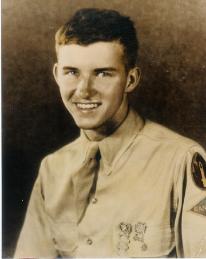
| Fred Clinton as a rough, tough, killer Ranger- March 1944 |