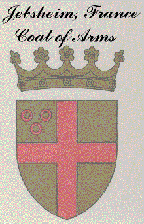
| The Battle of Jebsheim, France - from a French point-of-view. Page 17 |
| A TRAGIC BALANCE SHEET The loss in human lives in the fighting units were enormous on both sides. The exact number will never be known and can only be estimated. 500 German corpses, cited in the first official communique, nearly 200 French soldiers killed and at least as many Americans dead, add up to nearly one thousand dead. (WEBMASTER'S NOTE: ACTUAL AMERICAN DEAD WAS SIXTY-SIX FROM THE 254TH INFANTRY REGIMENT). To these must be added more than a thousand wounded, many of whom died in the ambulances and hospitals. For example in the 3rd Company of the Medical Battalion, from 27 January to 3 February, 602 wounded were treated, 29 of whom died while waiting treatment. If the Allied soldiers killed at Jebsheim were moved very quickly towards the rear, this was not the case with the German dead. A routed army does not have time to carry away its dead; everyone is trying to save his own skin and if flight is no longer possible, they can only die or surrender. The occupation authorities were no longer here and those named by the new government had not yet arrived. And so, for a long time, the bodies of animals and German soldiers lay in the courtyards and gardens. It was only with the thaw when a pestilential odor began to spread throughout the village, that groups of civilians were requisitioned to bury all the cadavers in order to avoid an epidemic. The bodies of men and animals, the tattered remains and debris of all sorts, were buried by men who were barely able to surmount their feelings of horror and disgust, in heaps in the large bomb craters- one was as deep as a one-story house. It was necessary to wait many years before the soldiers had a grave worthy of human beings. During the summer of 1945 and even the following years, many bodies were unearthed in the fields and neighboring forests, by plow and tractors. The last two German bodies were found during the 1960s, when a gas pipeline was being laid to the east of the village. DESTRUCTION AND CIVILIAN VICTIMS 1. Destruction: In these numbers are included buildings destroyed in 1940 Destroyed: 46 Houses---56 Barns---54 various buildings--one Church--one Train Station--one City Hall--one School--one Depot belonging to the Agricultural Cooperative. Damaged: 72 Houses--45 Barns--73 Various buildings. That makes a total of 118 houses, 101 barns and 127 various buildings that were hit by shells, bombs, incendiary bombs, bazookas, mortars, machine guns and other weapons. 2. Civilian Victims: Given the number of soldiers killed and the great destruction of buildings, everyone considers it a miracle that there were not more victims among the 600 to 700 civilians huddling in makeshift shelters throughout the battle. Five were killed: Mr. Jean Herrmann--by bullets Mrs Jerg (Hilda Cathel)---by fire Mr.George Oberlin----by shell fragments Miss Jenny Ziommerlin---by aviation bomb Mr. Robert Herrmann----at the Neuf-Brisach bridge Four were seriously injured. And we must not forget the three inhabitants of Jebsheim, who died on the field of honor in the French Army and the 13 inhabitants who were inducted by force into the Wermacht, and who died for a cause that was not theirs. ST MARTIN'S CHURCH OF JEBSHEIM: During the hard fighting of January 1945 the gable of the Romanesque facade was damaged again. It was not possible to complete the restoration of the facade until 1956. The tricolor flag (The French flag) that floats proudly in the breeze over the church today was raised immediately after the liberation by Mr. Albert Hild (Future Mayor of Jebsheim) and Mr. Emile Scherer (Londoner). This is proof of the patriotism and also the courage of these two inhabitants of Jebsheim. THE ALSATIANS AMONG THE COMBATANTS There is a popular saying that you cannot go anywhere in the world without meeting an Alsatian. Since we know that an Alsatian was implicated in the attempted assassination of the Fuher of such sinister memory, another in the escape of General Giraud into Switzerland and an Alsatian was among the first men on the moon--Schweickhart, whose father was originally from the Bas-Rhin, a Department of Alsace, it would have been astonishing had there not been a group of Alsatians among the combatants of the two sides in the battle of Jebsheim at the end of January 1945. This also explains the completely justified anguish of those inhabitants who saw one of their own forced to join the Wehrmacht, or volunteer, usually under a false name, to join the French army of the liberation. 1. On the German side there are few names. It is true that the Wehrmacht never trusted Alsatians very much. "They look French" they would say, and send them to the Russian or Italian fronts or to the Balkans. --A citizen of Colmar took advantage of the good fortune, at the moment they were crossing the Rhine, to get himself taken prisoner at Jebsheim. He crawled towards a French tank and ended the war with them, serving as an interpreter. -- One of our fellow citizens who was forced into the Wehrmacht came home on leave, hid out with some relatives and on 26 January introduced himself to the Americans who furnished him with one of their uniforms in order for him to avoid reprisals, in case the Germans came back. -- Another inhabitant of Jebsheim who had been inducted into the Wehrmacht took advantage of a leave to desert. Hiding out with some neighbors, he wisely awaited the conclusion of hostilities before rejoining his family. --Another of our fellow citizens who had been forced to join the enemy, came from Marckolsheim with German reinforcements and advanced as close as 100 meters to the house were he was born. At the last minute, he was unable to escape and had the misfortune to be taken prisoner by some Americans who spoke no French. They took him to the other side of the Vosges Mountains where he remained for three months. 2. On the side of the troops of the liberation: The tanks of the Regiment of African Riflemen, the Shock Battalion, the French Forces of the Interior, all the fighting units without exception who fought at Jebsheim had a number of Alsatians among them. These men surprised the inhabitants by calling out to them in Alsatian, rekindling hope by telling jokes in Alsatian dialect to the despairing civilians who thought they would never come through alive. Our Alsatian soldiers were admired with envy by the women who had a son or a husband far away and from whom they had received no news. Each year at the end of January, these men come back to us, to the scene of their exploits. --Heinrich from Mulhouse, Loessle from Colmar, Huss from the Bas-Rhin, all former paratroopers who never miss an opportunity to be with us and to shake the hand of the former leader, General Faure. --Loos from Colmar with his tank-destroyer of the 6th CC. George Hitter from Colmar, who died in his tank, the "Alsace." --Jules Fleith from Jebsheim, inducted by force by the Germans, who deserted his unit and returned with French troops to Henri Oberlin's farm. --Chalot Selig from Jebsheim, who proudly introduced himself to his fellow citizens in the uniform of the French Army. --The Shock Battalion finally, the company of Lieutenant Durrmeyer, which counted 20 or so Alsatians among them, all volunteers. And did you know that most of the men in the Shock Battalion were former inductees by force in the German Army? That having deserted on the Russian front, going over after enormous difficulties to the Russian side, interned in the terrible camp of Tambow, taken to North Africa to be released as a result of the agreement between General De Gualle and the Russians, these men then volunteered to join the Shock Battalion to fight against those whose detested uniform they had been forced to wear the year before. And last, a great sorrow overcomes us in evoking the name of our comrade from Colmar, Francois Ehlinger, who, after the Russian front, Tambow, North Africa, the Alsatian campaign, was seriously wounded as he advanced towards his objective and died just 12 kilometers from the house where he was born and his city of Colmar that he had come to liberate. |