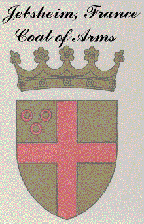
| The Battle of Jebsheim, France from a French point-of-view. Page 9 |
| THE CIVILIAN POPULATION DURING THE BATTLE OF JEBSHEIM Starting on 22 January, the misfortunes began and claimed the first victims. The Germans had set up a communications post in a house at the beginning of East Street (la rue de l'Est) and in the house at 22 Reed Street (la rue des Roseaux), near the intersection of Ostheim Street. Allied planes came and bombed these two objectives. A bomb fell at the entry to East Street (J J Selig's farm) and seriously wounded two people, Mr. Fritz Rieg of Jebsheim and Mr. Feuerbach, a refugee from Illhaeusern. A few seconds later, two bombs fell at the intersection of Reed and Osthem Streets, killing an eighteen -year old girl, Miss Jenny Zimmerlin. The second civilian victim was Mr. Robert Herrmann who, requisitioned, to lead some cows to Vieux-Brisach with other men from Jebsheim was hit by a shell near the Neuf-Brisach bridge and later died at the hospital at Colmar. In the night of 26-27 January, Mrs. Berthe Frey, wife of Alfred Scherer and Mr. George Selig were wounded in Ostheim Street. She was aided by American soldiers, then evacuated by French soldiers across the Ried River to Ribearuville and Ste-Marie-aux-Mines. On 28 January, Mr. George Oberlin, seriously wounded by a shell, was taken by German soldiers to Neuf-Brisach where he died. In the night of 28-29 January, Mrs Jerg (Helda Cathel) and Mr. Jean Herrmann were killed in the upper village. And this is how the people of Jebsheim lived out these memorable days. Not just the days of 27, 28 and 29 January; for long before that, they were living in cellars, listening to artillery and aviation fire regularly raking the village, which was full of German soldiers. And for a long time after January 30, German artillery in its turn, fired on Jebsheim, forcing civilians to remain in their cellars--sometimes they even had to find new shelters. It was only after the departure of the last Allied soldiers from Jebsheim, that the inhabitants could move back into their homes and make them temporarily livable. But let's listen to them by reading their stories. As far as possible, we have placed the stories in order to follow the progress of the Allies towards the upper village, that is to say towards the south., These accounts confirm, for the most part communiques sent out by the Allied troops.--25 January, the Mill; 26 Jan, Ostheim Street; 27 Jan the village as far as the church: 28 Jan, as far as Linden-tree Square and Riedwihr Street and part of East Street: finally 29 January the upper village. We have had to omit certain things and not repeat each time the problems of sanitation and provisions that were the lot of each island of refugees. We must not bore the reader by repeating each time the danger of death to which all thee witnesses were constantly exposed. THE NEXT SECTION OF THIS ACCOUNT OF THE BATTLE OF JEBSHEIM WILL INCLUDE THE PERSONAL ACCOUNTS OF CITIZENS OF JEBSHEIM WHO WERE IN THE VILLAGE AT THE TIME OF THE BATTLE * * * * * * * * * * * * * * * * * * * * * * * * * * * * * * * * * * * * * * * * * * * * * * * AT THE MILL OF JEBSHEIM, THE OBJECT OF BITTER FIGHTING WITH LARGE LOSSES OF MEN AND EQUIPMENT- MR DANIEL OBERLIN, 52 YEARS OLD The mill of Jebsheim is located 1500 meters from the village on the road to Ostheim, near the stream that we call "The Canal." It has belonged to the Berckheim family since the Middle Ages, but ceased working in 1916. It was inhabited by the Oberlin family who farmed there. But, let's listen to the son, Mr. Daniel Oberlin, today adjunct to the mayor, who was 14 years old at the time of the battle. Evacuated in 1940 like all the inhabitants of Jebsheim, we have sought refuge at the house of friends in Riquewihr, while our livestock was at Beblenheim. After our return here in 1940, we began farming at the mill again , that in the meantime had been declared "enemy property". In September 1944, we see the first German soldiers arrive-=-six or eight men with an NCO. They quartered at our place and mined the two bridges that lead to the Ried and also the bridge at Maison Rouge. Then, day and night, one of them is posted at each bridge to prevent sabotage and, if need be, to blow up the bridges. At the end of January 1945, the Germans install two 105 cannons in front of the mill, in trenches dug by requisitioned civilians. When the artillerymen fired a few trial shots, a soldier on guard said to me, "Well, that's it. Now those of the other side will know where we are". And sure enough, in no time at all, two smoke shells came in from the direction of the Ried and landed not far from the mill. Then, little by little, the firing becomes more frequent -- planes begin to fly over and it was then that we decided to leave the house and take refuge in the mill itself where the walls were much thicker. On the morning of 25 January, everything was very quiet. I took my bike and my papers and went to the village to see my uncle, Charles Ludwig, to ask him if we could come and take refuge with him. Arriving in the village, I was amazed to see that the rooftops of houses that were covered with snow were dotted with big black spots. The snow had been melted by exploding shells, some of which were still smoking. My uncle agreed to let us come and I quickly went back to the mill to get our things. Coming out of the village, I passed a bunker next to the road. A German soldier who was there stopped me. " Where are you going young man?" "I'm going to the mill, where my parents live" "To the mill? Don't even think of it, you'll never get there. The Americans are there" I assured him that I had been there myself half and hour earlier and that there were no Americans there, and I went on my way. Once at the mill, my father loads a wagon with what was strictly necessary; food, a sow (alive) and two cows, which we tied to the wagon hitched to our two mules. At the moment of departure, planes passed overhead; we heard them firing, but my father remained calm and said: "Surely they will see that we are civilians and won't harm us" My mother and I were to follow on bikes. Our precious objects and silver had been hidden in a safe place in the hold under wheat. I can still see myself leaving with my mother who, in certain spots where the snow was too high, would run in front of me, pushing the bike " to make things go faster". The Germans had placed two anti-tanks in action --you could hear their firing in the distance, the noise of machine guns growing nearer, a sheet of smoke was spreading across the plain, from the smoke shells, and you could not see 50 meters in front of yourself. However, we arrived safe and sound at my uncle's where we remained night and day in the cellar.(In all there were about a dozen of us there). The next day, a German captain came to my uncle's house. He was dejected, harassed and almost deaf and said that everything was finished, that he had no more men and he asked if he could hide and wait the arrival of the Americans to surrender. My uncle, who fought in World War I, agreed, but he asks the captain to give him his revolver. Then the officer began to think about what he was doing and says that he cannot do that--so he refuses and asks where can he go. My cousin goes with him as far as the barnyard and the barn, then shows him the direction of the Rhine and the soldier disappears. On the dawn of the 27th, an unusual silence stretches over our part of the village, as suddenly cannons and machine guns are quiet. I climb up to a ventilator window and chance a look at the street. I see human forms that are still and spaced at regular intervals in front of houses as far as the beginning of Ostheim street. At the entrance to that street there is posted a kind of low box-like vehicle with an unusual shape (a jeep) behind it, tanks, tanks in Indian file, in front of the house on Ostheim Street. Shortly afterward, American soldiers enter the cellar and search the entire farm looking for enemy soldiers. We have been saved, but all danger is not past--on the path next to my uncle's property, the tanks still have to fight hard with the Germans who are positioned in Hardt Woods--what's more, the shells start to rain again on the roofs and in the yards. About 10 days later, when the soldiers have left the village, my family returns to the mill. Everything has been destroyed and burned--our silver, still where we left it, has been melted--everything we had hidden is lost. The only thing left standing is the bread oven in the kitchen. Therefore we must continue living with our uncle. Finally we were able to erect a shed in East Street on a piece of land that belonged to us. We lived here until the construction of our present farm in 1952. But for several months after the departure of the soldiers, my mother and I, every Saturday, would go to the mill to make the bread and do the washing. WEBMASTER'S COMMENT This next account is of particular interest to your Webmaster, in that #5 Ostheim Street is where I stayed for a couple of days after entering Jebsheim. Several years ago I had the pleasure of sitting with Mr Reinhart in the courtyard of his farm and spent several hours recounting our experiences and enjoying some of his homemade wine. During the war and the time I stayed in Mr. Reinhart's barn, along with his cows, I don't recall seeing him or the other citizens who were hiding with him, I might also add that I didn't see any of his great wine either. Mr. Reinhart died a few years ago and his old barn and farm have been completely remodeled, but not before I was able to get a couple of pieces of the structure.. OSTHEIM STREET, FARM #5 MR ROBERT REINHART, 77 YEARS OLD (At time of writing this account) We have been living in the cellar for several days to protect us from the shells that exploded at regular intervals in our neighborhood. The cellar is on ground level, but the walls are very thick and the ceiling is of thick cement. On the courtyard side we have piled up manure and bales of hay. There are 32 of us in all- among others, the Gaunitz, Jacques Reinhart, Selig (neighbors) and Ludwig Glaser families. We are giving shelter also to four refugees from Illhaeusern. In the night of January 25-26, 1945, exactly at 2 AM, and I am sure of the date, Mrs Salome Benz's barn, right opposite us burns. I run over to help the woman, 70 years old, who lives alone. We quickly load her personal papers and various objects in an old carriage and I help her to come to our place. But just as we are crossing the street, a hail of projectiles (shell bursts or grenades) falls on us. We throw ourselves flat in the gutter and wait for calm to return. At that moment, a German soldier coming from the direction of the Ried, passes by us. I ask him: "Are there other soldiers coming behind you?" He answers: " I am the last; in a half and hour the Americans will be here- take cover!" I showed him the barn that is burning and asks him if he is not willing to take the old lady to the center of the village where she has relatives. He agrees, takes her under wing and leaves with her, while I drive the carriage to my house. The two of them must have arrived safely, because a few minutes later, her sister and brother-in-law arrive and the three of us go to the burning barn to see if we can contain the damage. With buckets of water, we succeed in saving the house but it is too late to do anything about the barn. Suddenly, I hear a soldier moaning somewhere between the house and the neighboring farm. I run over; the soldier has a leg that is shredded. I pick him up on my shoulders and alert the brother-in-law and the old lady. But the brother-in-law is busy wetting the walls, and irritated, he yells at me: " Put him down and come over here!" "But, I've got an American!" I tell him. "Oh Goddam (O Gott verdammi!)" he swears, throws down his bucket and runs as fast as he can, with his wife, to tell the good news to the village. I carry my American in front of the barn that is still burning. In the light of the flames, I see other American soldiers who are gathering and I bring them their wounded comrade. An ambulance comes shortly and takes him away, with the other wounded, for he is not the only one. I return home. I am scarcely inside when three other Americans come in. The officer speaks a little French. He asks me what I am doing there. He sees that I am out of breath and that my clothes are soaking (from fighting the fire). I explain everything to him. Then, with a revolver in my back, I have to show him all the rooms in the house to see if there are any German soldiers hiding there. After the house comes the barn, the stable, the cellar occupied by civilians--no German is found. But it is not over. Still with the same officer, we visit the neighboring houses, towards the Reid, as far as Market Street (la rue du Marche) and School Street (la rue des Ecoles). I am not really afraid. I was a soldier in Algeria in 1927-28 and, even at that time, we had seen a lot of things over there! In front of Gerad Schmitt's hours (#13 School Street) a tank is posted. It is still dark. The American officer looks at a kind of enormous wristwatch that he is wearing, points his finger at the end of the street (towards the east) where the Clausen house is (#15 ) and says: "There are Germans there." He didn't realize how truthfully he had spoken because immediately a fusillade broke out. The officer threw himself down on one side of the tank between the tracks and I on the other side. At the first moment of calm, I fled, jumped over the wall and into the gardens on School street and ran towards the back of my farm. But I had to lie flat in the snow at several poinst because the Germans took me for an American and fired at me every time I got up. I finally got home. No one knew where I had been during the long hours of my absence and my wife was beginning to get worried. Our house was to be occupied by Americans. They enjoyed our schnapps, but not until I had tasted it in front of them first. On the evening of the 27th, they are all happy. One of them tells me that Jebsheim is taken and that they have advanced to the edge of the "neighboring village!" Astonished, I ask him: "But, did you pass the bridge?" "Bridge? What bridge? There is no water there" In fact, they had gotten only as far as the church and having seen the big no-mans land, towards the south, covered with snow, they thought the upper village was already "another village" that is to say Muntzenheim. They didn't know what yet awaited them, poor fellows at Jebsheim. It was January 27. Later, we would have French paratroopers in the house and then Americans again. All danger was not over, however, because shells hit the courtyard and the house. At the end of February, calm returned and we could finally take possession of our home once again. |