Birth and Death of a
World War II Army
Camp- Camp Van Dorn,
Mississippi- Page 3
World War II Army
Camp- Camp Van Dorn,
Mississippi- Page 3
99th Infantry Division
UR here: VanDornHis page1> VanDornHis page 2> VanDornHis page 3>
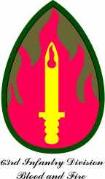
| The proud legend of the 63rd Infantry Division actually had its inception at Casablanca, North Africa during January 1943- five months prior to its formal activation. At his crucial stage of the war, the political and military leaders of the United States and Great Britain were engaged in conference to plan for the certain destruction of the heretofore dominant Axis war machine. In spite of the awesome uncertainties of the future, but as a means to emphasize its intent, the Conference flaunted the stirring promise: "that the enemy shall bleed and burn in expiation of their crimes against humanity". This declaration provided the inspiration and became the challenge for, then Brigadier General Louis E. Hibbs to mold one vital element of the combat force capable of subduing the professional Axis army and worthy to effect that solemn vow. It was he, shortly thereafter, who personally conceived the Division slogan and the insignia under which the men of his command would train and eventually fight. Blood and Fire 63rd, known and recognized by a shoulder patch showing an upthrust bloodied golden sword against a background of crimson flame. After basic and small unit training men of the Division were hardened to the rigors of living in the field, functioned fairly smoothly in their assignments and were anticipating advanced and larger unit maneuvers. This, however, was not to be. Special orders called for all qualified privates and privates first class, along with some non-commissioned and junior officers to bring other divisions, alerted for overseas movement, up to strength. This was time of mixed emotions for those remaining as the nucleus of a new 63rd Division. There was a feeling, in all honesty, of relief that the day of commitment was postponed but also disappointment that the men who worked so diligently together could not continue as the 63rd. This trying process was repeated twice again before the Division was at long last alerted as a unit for overseas assignment. The last inspections and final policing of company areas took place and the advance party boarded trains on 6 November 1944 for Camp Shanks, New York and Europe. The forward elements were the three (3) infantry regiments which were attached to other divisions in Europe until the other components of the 63rd arrived in January 1945. Their combat record will be review later in this research paper. Camp Van Dorn, of course, was loaded with many non-divisional units to include a WAC Detachment of approximately 120. Research pinpoints many types of non-divisional units: Engineers (camouflage, maintennance, combat), signal, ordnance battalions, medical outfits (ambulance and collecting companies), field artillery, quartermaster- name it and Van Dorn had some. One outfit, the 364th Infantry Regiment (Colored) a non-divisional unit- was ordered to Camp Van Dorn in May 1943 for retraining by Army Ground Forces. This unit was involved in two serious disturbances at their previous station, Phoenix, Arizona, where on Thanksgiving night of 1942, approximatley 100 men of the regiment engaged in a shooting affair with a detachment of negro military police with the result that one officer, one enlisted man and one civilian were killed and twelve enlisted men were seriously wounded. Sixteen members of this regiment were tried by general court-martial, each receiving a sentence of fifty (50) years. The 364th arrived at Camp Van Dorn in two groups. The first on 26 May and the second on 28 May 1943. Incidents of 29-30 May 1943, in which a private from the regiment was accosted outside the reservation by a military policeman and questioned about his improper uniform and lack of a pass, resulted in a fight. The county sheriff arrived about that time. The private attempted to flee and was shot and killed by the sheriff. Shortly after this incident a supply room was stormed by men of another company of the same regiment where they obtained a number of rifles. A crowd gathered near the regimental exchange when a riot squad made up of negro military policement fired into the crowd. One soldier was wounded by this volley. A month after the initial Van Dorn disturbances, the unit became embroiled again in an on post demonstration of near-riot proportions. This happened on the evening of 3 July 1943 at a service club where a dance was being held. The crowd refused to disperse and the officer of the day alerted a white unit and called for assistance. The unit alerted for assistance was a battalion of the 99th Infantry Division. This battalion arrived, cleared the hall, and dispersed the crowd, now grown to about 2,000. ( Note: Members of this battalion that were involved, I would appreciate a response from you). Aside from small headquarters detachmentrs, other Negro troops on post included two quartermaster truck regiments, one service battalion, one medical ambulance battalion and a quartermaster laundry company, totaling about 6,500 troops. After hearing many rumors concering the 364th, this writer feels that the above is the official record concerning these incidents. This information was published in a Department of The Army Special Series, the author being Ulysses Lee. Subject of this series was: The US Army in World War II- The Employment of Negro Troops (pages 366-370). Shortly after these incidents the 364th replaced a separate regiment in the Aleutians where it performed garrison duties for the rest of the war. Non-divisional units that were assigned to Camp Van Dorn were the 516th and 517th Quartermaster Truck Regiments. The American Trucking Association was called upon to secure volunteers to form two regiments to move war supplies (Lend-Lease) from the Persian Gulf to near the Russian border. This group of soldiers- truck drivers, terminal operators, dispatchers and so forth arrived at Camp Van Dorn in November-December 1942 and took their basic training here. Individuals related to me that the winter of 1942 was bitterly cold and they wondered how in the world it could get so cold and the water standing in the company streets did not freeze! These were Yankee-types too! Another non-divisional unit , the 165th Engineer Combat Battalion, born at Camp Van Dorn on 5 May 1943 writes in their unit history: " The cadre from Camp Gordon, Georgia arrived at Camp Van Dorn early in May in the midst of the staggering heat of that semi-equatorial State. Located in swamp country with semi-tropical vegetation and a complete set of insects, reptiles, and spiders an so forth and on and on." One of the most colorful outfits at Van Dorn was the 5th Infantry Regiment. Organized 16 Jul 1798. Fought brilliantly at the Battle of Tundys Lane in 1812. Spent years from 1815-1845 guarding the frontiers of the Northwest. Became part of General Zachery Taylor's forces and fought in the Mexican War. From 1846-1861 Indian fighting was their chief duty. The regiment spent a great deal of time in Panama transferring to Camp Van Dorn in early 1943. World War II service included 94 days in combat in the European Theater of Operations. The Regiment had 54 killed in action and 320 wounded. The regiment traveled 829 miles from initial commitment to final objective. |
17 Oct 13
| Contents |
